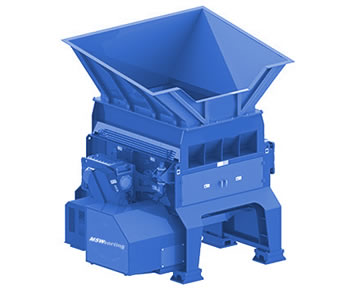
Single shaft shredder with shaft length greater than 1 meter
Based on MSWsorting sorting solutions
MUNICIPAL SOLID WASTE SORTING EQUIPMENT

Lightweight, non-recyclable waste materials with high calorific value enter the shredding box through the feeding system. The materials are shredded into small sizes by shearing, tearing, and squeezing between the knives, and materials of uniform small size are obtained after passing through the screen holes
A fine shredder is a specialized industrial machine designed to process lightweight, non-recyclable waste materials that possess a high calorific value. Often found within advanced waste management facilities like Material Recovery Facilities (MRFs) or Mechanical Biological Treatment (MBT) plants, it serves a critical function after initial sorting stages. Its primary purpose is to reduce the size of specific waste streams, such as certain plastics, textiles, or composite materials, transforming them into a uniform, finely shredded product. This processed material, often referred to as refuse-derived fuel (RDF) or solid recovered fuel (SRF), is prepared for subsequent energy recovery processes, making the fine shredder a key link between waste management and energy production.
Fine shredders are engineered with robust components to handle tough, abrasive materials continuously. A central feature is the heavy-duty shredding box or chamber, which houses the cutting mechanism. This mechanism typically consists of durable, rotating shafts fitted with hardened steel knives or hammers arranged in a staggered pattern. The design ensures materials are subjected to multiple cutting actions. Another crucial feature is the integrated sizing screen located at the bottom of the chamber. This screen, with precisely sized holes or grates, acts as a control gate, ensuring only particles small enough to pass through are discharged, thereby guaranteeing a consistent output size critical for efficient energy recovery.
The operation of a fine shredder is a continuous and powerful mechanical process. It begins when pre-sorted, lightweight waste is conveyed into the machine's feeding system, often using a belt conveyor or a hydraulic ram feeder that pushes material into the shredding chamber. Once inside, the waste enters the domain of the high-torque, slow-speed rotating shafts. The intermeshing knives on these shafts grab the incoming material. Instead of simply chopping, the action involves a combination of shearing, where opposing blades slide past each other to cut, and tearing, where the material is ripped apart by the rotational force and the geometry of the knives.
As the material is reduced, it is forced against the interior walls of the chamber and the sizing screen. The screen plays an active role in the process; particles small enough to pass through the holes are ejected, while larger pieces are retained within the chamber. These larger fragments are recirculated by the rotating knives, undergoing further shearing, tearing, and squeezing until they are sufficiently reduced. This closed-loop grinding action continues until all material meets the size specification, resulting in a steady flow of homogeneous, finely shredded fluff ideal for use as a high-quality feedstock for waste-to-energy plants.
Fine shredders are indispensable in modern waste management infrastructure, primarily within facilities focused on producing refuse-derived fuel (RDF). In an MRF or MBT plant, after recyclables like metals, plastics, and paper are removed, the remaining high-calorific fraction—often comprising mixed plastics, soiled paper, textiles, and wood—is directed to the fine shredder. Here, it is transformed into a consistent, high-energy-density fuel that can be co-processed in cement kilns or combusted in dedicated waste-to-energy facilities to generate electricity and heat, thus diverting waste from landfills and recovering valuable energy.
Beyond RDF production, fine shredders are also utilized in specific recycling lines that require extreme size reduction. For instance, they can prepare certain types of waste for chemical recycling processes or create a uniform feedstock for the production of composite materials. In some scenarios, they are used for the secure destruction of sensitive materials or to pre-treat waste before biological processing. Their ability to deliver a controlled, small particle size makes them versatile machines at the intersection of recycling, energy recovery, and advanced waste treatment technologies.
Integrating a fine shredder into a waste processing line offers significant operational and environmental benefits. The most prominent advantage is the creation of a high-quality, homogeneous fuel product. By producing a uniform particle size and increasing the material's surface area, the shredded waste burns more efficiently and completely in combustion systems. This leads to higher energy recovery rates, more stable operation of the energy plant, and reduced emissions compared to burning unsorted or coarsely shredded waste. It effectively upgrades low-value waste into a reliable, alternative energy resource.
From a system management perspective, fine shredders enhance overall facility efficiency. The volume reduction achieved through shredding can lower transportation and storage costs for the resulting fuel. Furthermore, by reliably processing tough and variable materials, they reduce downtime and maintenance issues in downstream equipment. Environmentally, their role is crucial in supporting the circular economy by enabling energy recovery from non-recyclable waste, significantly reducing the volume of material sent to landfill, and contributing to the reduction of greenhouse gas emissions associated with waste decomposition and fossil fuel use.
Based on MSWsorting sorting solutions

Based on MSWsorting sorting solutions

Based on MSWsorting sorting solutions
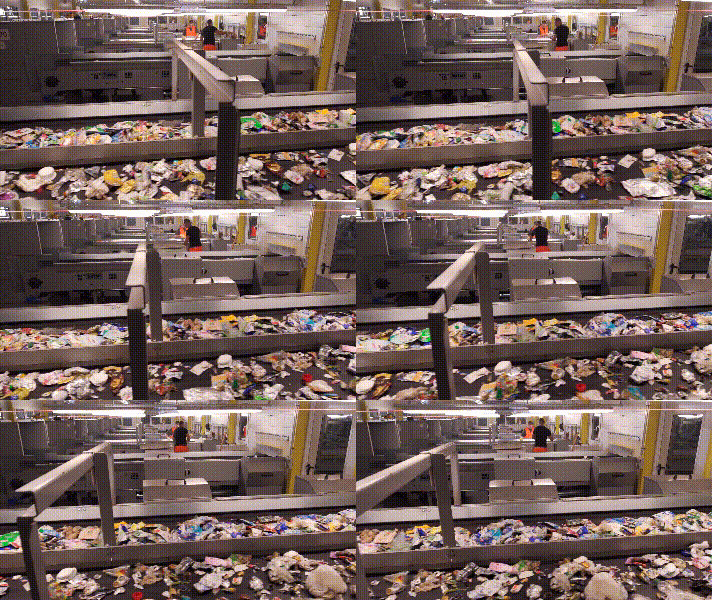
Belt ConveyorManual Sorting Room
For countries with low labor costs, a combination of mechanical and manual sorting can be used, which is a cost-effective waste sorting and recycling solution.
Read More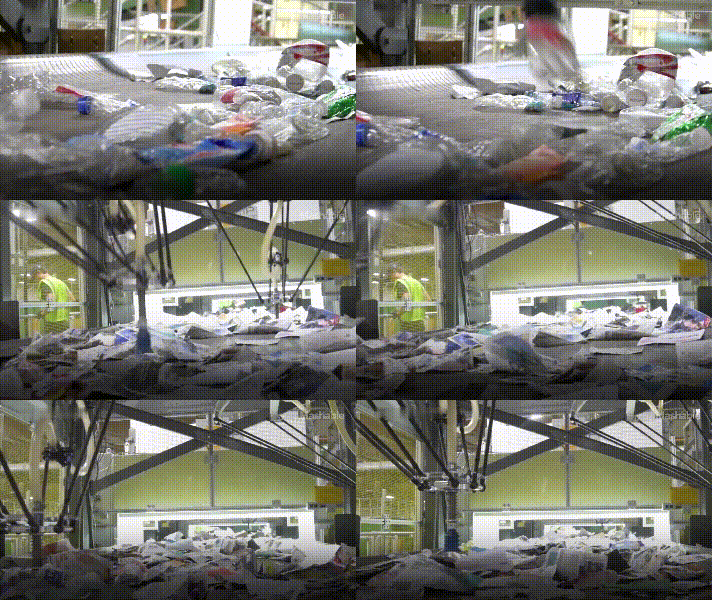
AI SortingSorting Robot
The artificial intelligence sorting robot with autonomous learning can practice and accumulate sorting data. It can effectively sort various high-value recyclables.
Read More
Optical Sorting
Optical sorter is a automatic sorting device based on sensors, high-speed ejector valve has large processing capacity. It is a good choice for bulk handling project of waste recycling.
Read More