2 stations manual sorting room
Based on MSWsorting sorting solutions
MUNICIPAL SOLID WASTE SORTING EQUIPMENT

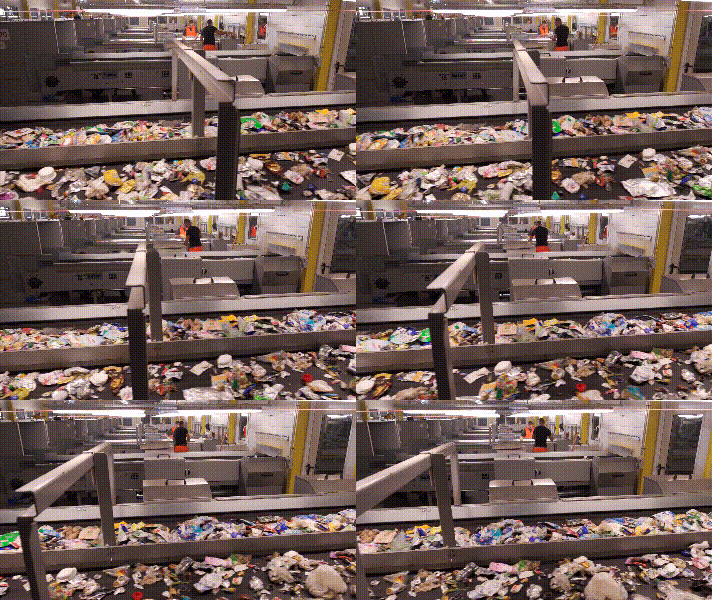
In the garbage sorting, recycling and processing line, it is sometimes necessary to manually sort interference objects and specific types of garbage. The sorting room is an important part of the manual sorting station. The sorting workers carry out garbage sorting operations in the spacious and bright sorting room. The sorting room is equipped with good ventilation and air conditioning devices to ensure the sorting The personnel operate in a good working environment.
A Manual Sorting Room is a dedicated, controlled workspace within a larger waste sorting and recycling facility, such as a Material Recovery Facility (MRF) or a Mechanical Biological Treatment (MBT) plant. While modern systems heavily rely on automated machinery like optical sorters and AI robots, certain tasks still require the precision and judgment of human workers. This room is specifically designed for staff to manually identify, pick, and separate specific types of waste or unwanted materials from the main waste stream. It acts as a critical quality control and refinement point in the recycling process.
The primary purpose of this room is to handle materials that automated systems might miss, find difficult to process, or incorrectly sort. For instance, workers might remove large contaminant items like textiles, hazardous waste, or specific plastic types that the machinery cannot yet accurately distinguish. It is a space where human expertise complements advanced technology, ensuring the purity of recovered materials like plastics, paper, and metals, which is essential for their value in the recycling market.
A well-designed Manual Sorting Room prioritizes worker safety, health, and efficiency. It is constructed to be a bright and spacious environment, illuminated by strong, shadow-free lighting that allows workers to clearly see and identify materials moving past them on conveyor belts. The room is fully enclosed to control the internal environment and is equipped with powerful ventilation systems that continuously extract dust and odors, replacing them with fresh, filtered air to maintain air quality.
Furthermore, climate control is a standard feature, with air conditioning or heating systems in place to ensure a comfortable temperature year-round, regardless of the conditions outside or in other parts of the plant. Ergonomic considerations are also key; the sorting stations are typically positioned at an optimal height to reduce physical strain, and personal protective equipment (PPE) such as gloves, safety glasses, and high-visibility vests is mandatory. These features collectively create a workspace that protects workers' well-being while enabling them to perform their sorting tasks effectively.
The operation of a Manual Sorting Room is integrated into the broader automated sorting line. After waste passes through initial stages like pre-shredding, bag opening, and screening by machines like trommels or ballistic separators, a targeted stream of material is directed to the manual sorting area. This stream is usually slower-moving and contains items that require human intervention. The material travels on a slow-moving conveyor belt that passes in front of several sorting stations where workers are positioned.
Each worker is trained to look for specific types of contaminants or valuable materials. As the conveyor belt moves, workers quickly scan the material, manually reach in, and pick out their assigned items. These items are then placed into separate chutes, bins, or onto adjacent conveyor belts that lead to dedicated collection points for different material types, such as a bin for film plastic or a chute for non-recyclable contaminants. The "cleaned" stream then continues on for further automated processing or is sent directly to baling for sale.
Manual Sorting Rooms are essential in several key areas of waste management. Their most common application is in Material Recovery Facilities (MRFs) for municipal solid waste. Here, workers perform critical quality control by removing contaminants that could jam machinery or reduce the value of bales of recyclables like cardboard, paper, and specific plastics. They are the last line of defense for ensuring the purity of the final product.
Beyond standard MRFs, these rooms are vital in specialized recycling plants that process complex waste streams, such as electronic waste (e-waste) or construction and demolition debris. In e-waste recycling, for example, workers manually disassemble devices to remove batteries, circuit boards, and other hazardous or high-value components before shredding. They are also used in facilities that sort commercial and industrial waste, where the waste stream can be less uniform and contain more unexpected items that automation cannot reliably handle.
Incorporating a Manual Sorting Room into a waste processing plant offers significant advantages, primarily in achieving higher material purity. Human sorters possess superior recognition capabilities for complex, deformed, or soiled items that optical sensors and robots may misinterpret. This leads to cleaner output streams of recyclables, which command higher prices in the market and are more desirable for manufacturers using recycled content. It directly enhances the economic viability of the entire recycling operation.
Another major benefit is operational flexibility and problem-solving. Workers can adapt instantly to changes in the waste stream, such as a sudden influx of a new type of packaging or contaminant, whereas reprogramming automated systems takes time. Furthermore, the room provides a crucial safeguard for machinery; by removing large, hard, or tangled objects (like wires, textiles, or wood) manually, it prevents costly breakdowns and jams in downstream equipment like crushers, screens, and automated sorters, ensuring smoother and more continuous plant operation.
Based on MSWsorting sorting solutions
Based on MSWsorting sorting solutions
Based on MSWsorting sorting solutions
Belt ConveyorManual Sorting Room
For countries with low labor costs, a combination of mechanical and manual sorting can be used, which is a cost-effective waste sorting and recycling solution.
Read More
AI SortingSorting Robot
The artificial intelligence sorting robot with autonomous learning can practice and accumulate sorting data. It can effectively sort various high-value recyclables.
Read More
Optical Sorting
Optical sorter is a automatic sorting device based on sensors, high-speed ejector valve has large processing capacity. It is a good choice for bulk handling project of waste recycling.
Read More