Width 1.2 Meter Flip Flop Screen
Based on MSWsorting sorting solutions
MUNICIPAL SOLID WASTE SORTING EQUIPMENT

The equipment has two vibrating masses, one of which is an elastic screen and the other is a counterweight. The material is thrown through the relaxation and tension movement of the elastic screen on the inclined screen box. When working, the screens are pulled alternately. Tight and slack, make the material produce forward bounce movement, and fly at different speeds, produce collision separation, pass through the sieve holes, and achieve the purpose of sorting.
A Flip Flop Screen is a specialized type of vibrating screen used extensively in modern waste sorting and recycling facilities, known as Material Recovery Facilities (MRFs). Its primary function is to efficiently separate mixed solid waste streams—such as municipal solid waste (MSW), construction and demolition debris, or commercial waste—into different size fractions. Unlike conventional screens that use a single, uniform motion, the Flip Flop Screen employs a unique dual-mass, alternating tension mechanism. This allows it to handle challenging, wet, sticky, or fibrous materials like household garbage, which often clog traditional screening equipment. By effectively separating finer organic material (fines) from larger, drier recyclables, it is a critical component in preparing waste for further processing by systems like optical sorters, air classifiers, and eddy current separators.
The name "Flip Flop" vividly describes its core operating principle. The screen itself is not a rigid, static mesh but an elastic panel. This elastic screen and a counterweight form two independent vibrating masses. During operation, these masses move in a coordinated yet alternating pattern, constantly changing the tension on the screen surface. This innovative design is what gives the Flip Flop Screen its remarkable ability to prevent blinding—a common problem where waste particles stick to and block the screen holes. It is particularly valuable in the early stages of a waste sorting line, following pre-shredding and bag opening, where the incoming waste stream is highly heterogeneous and often contaminated with moisture.
The defining feature of the Flip Flop Screen is its dual-mass drive system with alternating tension. One mass is the elastic screen panel itself, and the other is an adjustable counterweight. They are connected via a robust drive mechanism that pulls them in opposite phases. This creates a continuous cycle where one section of the screen is under high tension (tight) while the adjacent section is in a state of relaxation (slack). This "flip-flopping" action is not just a side-to-side shake; it imparts a powerful, forward-throwing motion to the material on the deck. The elastic nature of the screen panels allows them to stretch and snap back, adding a dynamic, bouncing effect that helps dislodge trapped particles and ensures consistent material flow across the entire screening surface.
Another crucial feature is its high resistance to clogging and blinding. The alternating tension constantly changes the geometry of the screen openings, preventing particles from becoming permanently lodged. This makes it exceptionally effective for screening moist organic waste, plastics film, paper, and other problematic materials. Furthermore, the screen box is typically installed at an incline. Combined with the vigorous forward-throwing motion, this incline ensures that oversized material that cannot pass through the holes is efficiently conveyed off the discharge end. The machine's robustness is also a key consideration, as it is built to withstand the abrasive and corrosive environment of a waste processing plant, with wear-resistant materials used in critical areas.
The operation of a Flip Flop Screen is a dynamic process of controlled, alternating vibrations. Mixed waste material is fed onto the inclined screen deck at the upper end. As the machine is activated, its drive system begins to rhythmically pull the two vibrating masses. Imagine the elastic screen deck like a trampoline sheet that is repeatedly pulled tight and then allowed to go slack in a wave-like pattern across its width. When a section of the screen is pulled taut, the openings become slightly smaller and more defined, and material on that section is propelled sharply forward and upward. Immediately after, as that section goes slack, the openings relax and expand, allowing smaller, eligible particles to fall through under gravity.
This cycle happens rapidly and continuously across the entire screen surface. The waste particles experience a unique combination of forces: they are thrown forward during the tension phase, collide with other particles and the screen surface, and are given opportunities to reorient themselves during the relaxation phase. Smaller particles, such as dirt, glass shards, fine organic matter, and small plastics, find their way through the screen holes during these moments of relaxed opening and fall onto a conveyor below as the "undersize" fraction. Larger items, like plastic bottles, cans, cardboard, and textiles, which are too big to pass through, continue their journey up the inclined deck, bouncing and tumbling due to the flip-flop action, until they are discharged at the top as the "oversize" fraction. This effective separation creates two distinct material streams for subsequent sorting stages.
Within the waste management industry, Flip Flop Screens are indispensable in Material Recovery Facilities (MRFs) and Mechanical Biological Treatment (MBT) plants. Their primary application is size-based separation after initial waste processing. For instance, after municipal solid waste has been pre-shredded and bags have been opened, the entire mix is fed to a Flip Flop Screen. Here, it performs a critical task: separating the fine, often wet, organic fraction (fines) from the larger, drier recyclable materials. The undersize fraction, rich in organic material, can be sent for composting, anaerobic digestion, or landfilling, while the cleaner, oversized fraction proceeds to a series of advanced sorters like magnets, eddy current separators, optical sorters, and AI robots to recover plastics, metals, and paper.
Beyond standard MRFs, Flip Flop Screens are also vital in processing specific waste streams. They are highly effective in Construction and Demolition (C&D) waste recycling plants for separating fine soil and rubble from larger wood, metal, and plastic pieces. In commercial and industrial waste sorting lines, they handle mixed packaging waste. Furthermore, in composting facilities, they are used to screen out oversized, non-compostable contaminants from the finished compost product. Their ability to handle damp, sticky materials without clogging makes them the preferred choice over trommel screens or traditional vibrating screens in many applications where material moisture content is variable or high.
The most significant benefit of using a Flip Flop Screen is its unparalleled efficiency in screening difficult, "hard-to-screen" materials. Its self-cleaning action virtually eliminates downtime for manual cleaning of clogged screens, which is a major bottleneck with other technologies. This leads to higher operational throughput and more consistent product quality in the separated streams. By reliably removing fine organic material early in the process, it protects and enhances the performance of downstream equipment. For example, optical sorters and air classifiers work much more accurately on a stream of larger, drier items than on a mix contaminated with wet dirt and food residue, increasing overall plant recovery rates and purity of recyclables.
From an economic and operational standpoint, Flip Flop Screens offer substantial advantages. Their robust design and reduced clogging result in lower maintenance requirements and longer service life for screen panels. The improved quality of the oversized fraction (less contamination by fines) translates directly into higher market value for the recovered recyclables. Furthermore, by efficiently separating organic fines, they reduce the volume and moisture content of material sent to subsequent, often more energy-intensive, sorting stages, optimizing the plant's overall energy consumption. In summary, the Flip Flop Screen is a cornerstone technology that boosts the efficiency, profitability, and reliability of modern automated waste sorting systems.

Based on MSWsorting sorting solutions

Based on MSWsorting sorting solutions

Based on MSWsorting sorting solutions
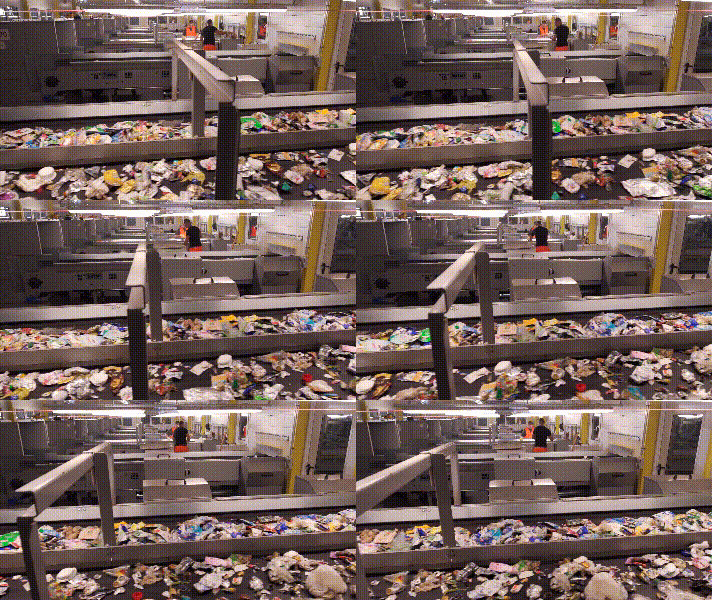
Belt ConveyorManual Sorting Room
For countries with low labor costs, a combination of mechanical and manual sorting can be used, which is a cost-effective waste sorting and recycling solution.
Read More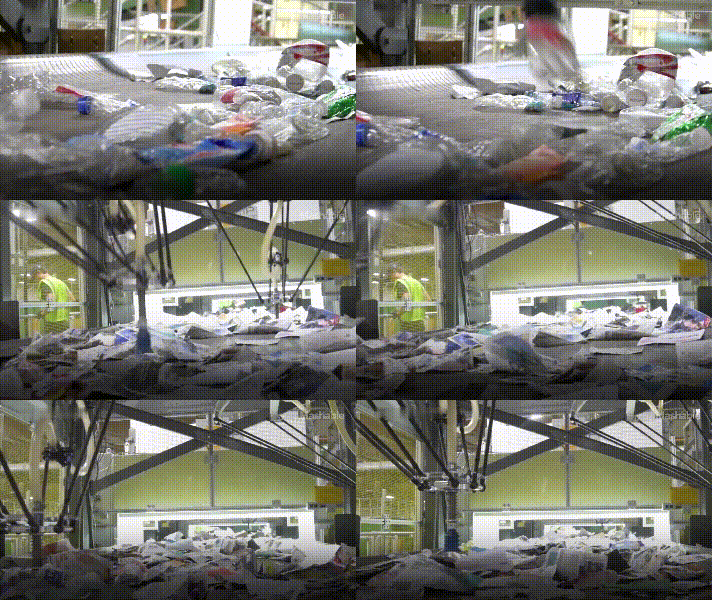
AI SortingSorting Robot
The artificial intelligence sorting robot with autonomous learning can practice and accumulate sorting data. It can effectively sort various high-value recyclables.
Read More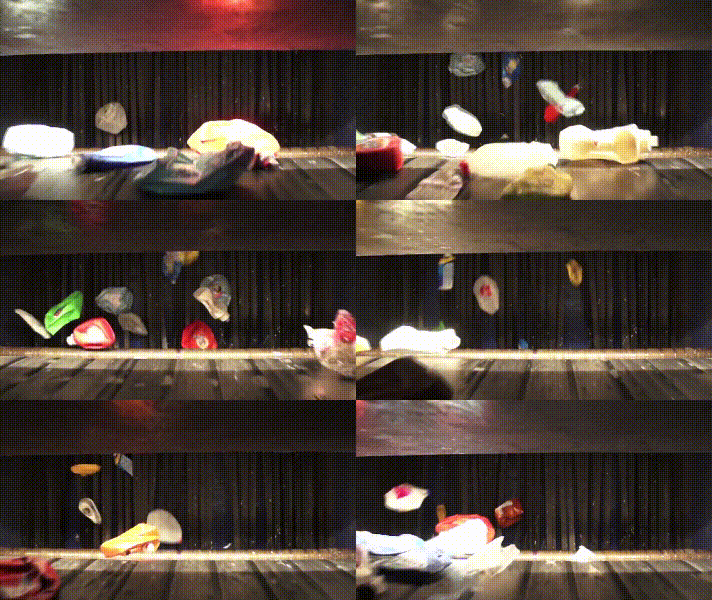
Optical Sorting
Optical sorter is a automatic sorting device based on sensors, high-speed ejector valve has large processing capacity. It is a good choice for bulk handling project of waste recycling.
Read More