Push forward or turn over type metal baler
Based on MSWsorting sorting solutions
MUNICIPAL SOLID WASTE SORTING EQUIPMENT

The horizontal metal briquetting machine directly cold-presses various solid bulk metal materials, suitable for metals compaction and baling (beverage cans, wire, etc.). The machine must be capable to reach very high densities of the produced bales to facilitate storage, logistics, or recycling.
A Metal Baler is a powerful industrial machine designed to compress and bind loose metal scrap into dense, manageable blocks called bales or briquettes. It is a crucial piece of equipment in the recycling industry, transforming piles of discarded metal items—such as beverage cans, wiring, sheet metal offcuts, and other solid bulk materials—into compact, uniform packages. By doing so, it prepares these materials efficiently for the next stages in the recycling chain, whether that's storage, transportation to a processing facility, or direct melting in a furnace.
Unlike simple compactors, a Metal Baler applies immense pressure in a controlled manner, typically through a hydraulic system, to achieve a very high density in the final bale. This process is usually performed at room temperature, known as cold-pressing, which preserves the properties of the metal for recycling. The machine's robust construction allows it to handle the tough and often abrasive nature of metal scrap, ensuring durability and consistent performance in demanding industrial environments.
Modern Metal Balers are engineered with several key features that define their efficiency and capability. A primary feature is their high-pressure hydraulic system, which is the core of the baling process. This system generates the tremendous force required to compress even the most resilient metal scraps, such as tangled wires or thick aluminum sheets, into tightly packed bales. The pressure can be precisely controlled, allowing operators to achieve the optimal density for different types of metal, ensuring each bale is solid, stable, and safe to handle.
Another critical feature is the machine's robust chamber and pressing head, constructed from heavy-duty steel to withstand constant stress. Many balers are fully automated, featuring programmable logic controllers (PLCs) that manage the baling cycle—from feeding and compression to tying and ejection. Safety is paramount, so these machines are equipped with comprehensive safety interlocks, emergency stop buttons, and protective guards. Furthermore, their design often focuses on energy efficiency, reducing power consumption during operation, and ease of maintenance to minimize downtime in busy recycling facilities.
The operation of a Metal Baler is a systematic process that turns loose scrap into a neat bale. It begins with the feeding stage, where workers or a conveyor system load loose metal scrap into the machine's large charging box or chamber. Once the chamber contains a sufficient amount of material, the hydraulic system activates. A massive hydraulic ram, or pressing head, moves forward with immense force, compressing the scrap metal against a fixed wall inside the chamber. This action crushes and deforms the materials, eliminating empty air spaces and consolidating them into a dense block.
After the initial compression, the ram may retract, allowing for more material to be added if producing a larger bale, or it may hold pressure. Once the desired density and bale size are achieved, the next phase begins: binding. Automatic wire-tying systems or strapping devices then wrap strong steel wires or bands around the compressed block to secure its shape. Finally, the rear door of the chamber opens, and the ram gives a final push to eject the finished, tightly bound bale onto a waiting conveyor or collection area, ready for the next step in its journey.
Metal Balers have a wide range of applications across various sectors that generate or handle metal waste. The most prominent application is in Material Recovery Facilities (MRFs) and dedicated scrap metal recycling yards. Here, they are indispensable for processing the stream of collected metals, including ferrous metals like steel and iron (often separated by magnets) and non-ferrous metals like aluminum, copper, and brass. By baling these materials, facilities can drastically reduce the volume of scrap, making storage and handling far more efficient and economical.
Beyond dedicated recycling centers, Metal Balers are also vital in manufacturing and industrial plants. Automotive factories, appliance manufacturers, and metal fabrication shops use them to manage production offcuts, defective parts, and turnings. Supermarkets and distribution centers may use smaller balers specifically for aluminum cans collected for recycling. Even in shipbreaking and demolition industries, large-scale balers help process the enormous quantities of metal recovered from structures, transforming chaotic piles of debris into standardized, shippable commodities.
The benefits of using a Metal Baler are substantial, primarily centered on economic and operational efficiency. The most immediate advantage is the dramatic reduction in storage space required. Loose metal scrap is bulky and difficult to stack, whereas uniform, dense bales can be neatly piled high, optimizing warehouse or yard space. This volume reduction directly translates to lower storage costs. Furthermore, transportation becomes significantly more cost-effective. More material can be loaded onto a single truck or shipping container when it is baled, reducing the number of trips needed and cutting fuel and logistics expenses.
From a processing and safety standpoint, baling metal scrap offers clear advantages. Dense bales are easier and safer to handle with forklifts and cranes compared to loose, jagged piles of scrap, which reduces the risk of workplace injuries. The consistent shape and weight of bales also streamline downstream recycling processes, such as feeding materials into shredders or furnaces, leading to more efficient melting and higher quality recycled metal output. Finally, by facilitating efficient recycling, Metal Balers play a crucial role in the circular economy, conserving natural resources, saving energy compared to virgin metal production, and reducing the environmental footprint of waste.

Based on MSWsorting sorting solutions

Based on MSWsorting sorting solutions

Based on MSWsorting sorting solutions
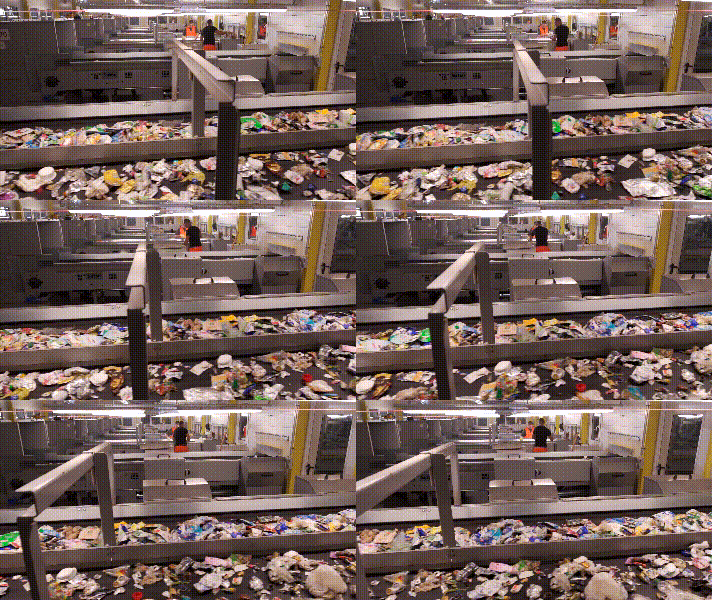
Belt ConveyorManual Sorting Room
For countries with low labor costs, a combination of mechanical and manual sorting can be used, which is a cost-effective waste sorting and recycling solution.
Read More
AI SortingSorting Robot
The artificial intelligence sorting robot with autonomous learning can practice and accumulate sorting data. It can effectively sort various high-value recyclables.
Read More
Optical Sorting
Optical sorter is a automatic sorting device based on sensors, high-speed ejector valve has large processing capacity. It is a good choice for bulk handling project of waste recycling.
Read More